If you've watched some of our episodes here on SciShow Space, maybe you've noticed this:
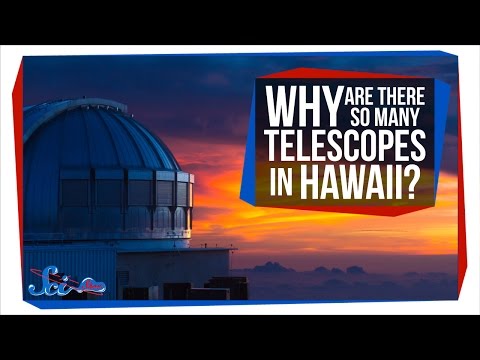
whenever we mention a ground-based telescope, it's almost always in either Hawaii or Chile.
That's because there are dozens of super-advanced research telescopes clustered in those very
specific places.
It turns out that there are good reasons why astronomers build telescopes there — and
it's not just because Hawaii's gorgeous.
Researchers use these telescopes to detect signals that are incredibly faint, so they
have to build them in places where they'll pick up the least interference.
The kind of location you might find attractive for your telescope will depend on what you
want to observe, and what kind of telescope you're building.
You need to think about what sections of the sky you want to study, because the night skies
in the northern and southern hemispheres are different.
So if you want to be able to observe everything we can see from Earth, you'll need to build
at least two telescopes, one in each hemisphere.
But it's not just about hemispheres.
You also need to take into account what kind of wavelengths you're going to observe in.
Telescopes can be sensitive to different ranges of wavelengths on the electromagnetic spectrum,
because different ranges are good for observing different things.
For instance, if you want to study something really old, you're probably going to want
to use longer wavelength ranges, like microwave and radio.
But if you want to study something that's giving off lots of energy, you want to use
shorter wavelength ranges, like X-rays.
And you'll get better results in different environments, depending on what wavelength
your telescope uses.
Deserts and mountains are especially popular places to build telescopes, because they maximize
what's called seeing.
No, seriously.
That's the technical term.
"Seeing" describes how much atmospheric disturbance there is.
A churning, turbulent atmosphere distorts visible light, and it's what causes stars
to appear to twinkle to us.
Good seeing means low atmospheric disturbance, and it's especially important to have good
seeing if you're observing in infrared or visible wavelengths.
If you're somewhere high and dry, like the top of a mountain, your atmosphere will be
thinner and less humid, which means better seeing.
The summit of Mauna Kea, the largest volcano in Hawaii — and the second-tallest in the
solar system! — has the best seeing in the whole northern hemisphere.
It's so tall that its peak is above the height where water vapor typically stays in
the atmosphere, which makes it taller than most clouds!
And because it's so tall, the air up there is very thin.
So there are a whole bunch of telescopes up on Mauna Kea that use infrared and visible
light.
In the southern hemisphere, the Atacama desert has the best seeing, because it's the driest
desert in the world that's not Antarctica.
And, because it's part of the Andes, it has a very high elevation.
So the Atacama is also full of telescopes.
There are three big observatories with lots of telescopes down there: La Silla, Paranal,
and Llano de Chajnantor.
All three sites together have at least fifteen active telescopes.
High and dry is also a great rule for building telescopes that use the part of the microwave
range called millimeter/submillimeter.
But not because we need to maximize seeing.
As light passes through the atmosphere, it interacts with water vapor.
And when the bonds in water interact with microwaves, they start vibrating a ton.
This makes microwaves great for heating up your frozen burrito, but awful for millimeter/submillimeter
astronomy in humid places.
In high humidity, you won't be able to see past the sky and into space; you'll just
see a big, bright, all-consuming glow.
So, the same places that are great for infrared and visible light astronomy are also great
for millimeter/submillimeter astronomy.
But what if you want to observe in longer wavelengths?
If you're using a radio telescope, you don't have to worry about atmospheric interference
as much as you have to worry about interference from other people.
You use radio waves to listen to Rihanna, call your parents, and scroll through tumblr,
and all those radio waves will interfere with a radio telescope.
So, around radio telescopes, you'll often find a radio quiet zone.
These are places where there are very strict rules about what kind of radio technology
you're allowed to use.
The biggest quiet zone in the US is the National Radio Quiet Zone, or NRQZ, which is mostly
in West Virginia.
It's home to the Green Bank Observatory, a massive radio telescope.
In the NRQZ, the only radio transmissions allowed are emergency transmissions and low-powered
transmissions, like ham radio and a few local radio stations, and most people don't even
have cell phones because they can't use them unless they go out of town.
But it's totally worth it: that quiet zone has allowed the Green Bank Observatory to
make groundbreaking discoveries on everything from gravitational waves to astrochemistry.
So that's why you hear about Hawaii and Chile so much in astronomy.
Telescopes are finicky, but if you put them in the right spot, you can learn amazing things
about the universe.
Thanks for watching this episode of SciShow Space, and thanks especially to our patrons
on Patreon who help make this show possible.
If you want to help us keep making episodes like this, just go to patreon.com/scishow
to learn more.
And don't forget to go to youtube.com/scishowspace and subscribe!
 For more infomation >> Q&A | ANIME - GIRL'S K-POP GROUPS - COSPLAY - Duration: 2:59.
 For more infomation >> 50 curiosidades Dani Daniels! - Duration: 8:07.



 For more infomation >> Giro d'Italia tra i profumi delle autostrade | Le tappe | Parodia - Duration: 1:21.
  For more infomation >> 297 साल बाद 10 मई को वैशाख पूर्णिमा पर है दुर्लभ योग, एक उपाय देगा अपार धन | Vaishakh Purnima 2017 - Duration: 4:07.


 For more infomation >> Sergio Ramos, sobre la campaña del Atlético: "Parece que nos hemos criado en Beverly Hills" - Duration: 0:43.
 For more infomation >> I WISH - Anime Crack #13 - Duration: 1:58.


Không có nhận xét nào:
Đăng nhận xét