I have a young child, and I was thinking how no child was born to be homeless.
Because I work with homeless people on an everyday basis,
and I'm not saying I don't want my child to be like them. No, not at all.
It's so true that they weren't born to be homeless.
I'm sure for the homeless, they had moments like my child,
where they were loved,
There were people who were pleased by the small things they did,
Moments like that.
I think we shouldn't forget they were once babies that were loved.
I learned a lot of things when my child was born.
Sanyukai is a non-profit and its goal is to help the homeless and former homeless
around the area of San'ya, Tokyo's skid row.
Although as far as skid rows go, I got to say, it's quite orderly and clean.
While Sanyukai only has 10 staff, it has over a hundred volunteers,
which include former homeless people themselves.
Beyond the free health care, food, and temporary shelter they provide,
perhaps the most important aspect of their mission
is the personal connection they make with these mostly senior men.
Here's what they had to say about becoming homeless.
I wasn't born into a wealthy family.
My parents weren't farmers, they were white collar workers. I was also the youngest child.
Did you come to look for a job in Tokyo?
Yes. Yes.
It wasn't like I didn't have any money at all.
It's just that the company I worked at went bankrupt. Yeah.
I was about 43 when the oil shock happened. The first oil shock... or the second?
Then I resigned my job as they were looking for volunteers.
They were trying to reduce the number of employees.
I quit my job then, and then
I got a job at a construction site.
I was working at a construction company
making ends meet, and then
when I was 45 or 46,
it became hard on my body
working at a construction site,
and working night shifts, staying in a dormitory.
Since I was 60... Heisei 20...
I have been on livelihood protection since Heisei 22 (2010).
I was working before but the company went bankrupt.
And then, stupid me, I didn't change my home address when I moved.
So I had a tough time finding a job without a local address.
So I was a homeless for about 5 or 6 years.
5 or 6 years living outside?
Living on the street. I was collecting cans, aluminum cans.
Well, I earned about 3000 yen, 4000 yen when it was good.
While these men have all found shelter off the streets, it wasn't always like that for them.
It's for that reason that Sanyukai makes meals on a daily basis,
where they sometimes serve over a hundred people.
In my original voice over script, I was going to talk about how they made meals,
but I became aware that if you simply watched,
you'd realize this operation was a well oiled machine, no explanation necessary.
Once the meals are made, they take the food to a predetermined location,
today under a highway, where people made up two lines to receive the food.
Everyone got a ticket and five per line were sent to get their meals.
Everything was so organized and fast,
that I truly was running around with my camera trying to capture the entire scene before it was over.
And boy was it over fast.
With 62 people that day, the initial serving was done in under 5 minutes.
I had to check my timestamps to really be sure that it all happened so quickly.
2 more people, 2 more people.
Thank you very much.
After the first serving, people could line up for seconds.
And what do you know, 7 minutes after it all started, it was already over.
Since this was the beginning of the month,
the number of people was much smaller than at the end, when money starts to run out.
For people who qualify, the government does provide livelihood protection, or seikatsu hogo.
So I asked about it.
Basically anyone can get it.
Basically.
However, some people simply
don't know the system exists.
Though they know about it, they don't know who to talk to, or,
depending on the municipality,
if you don't have a home address,
you're not eligible for local benefits.
The office doesn't even talk to you,
or rejects you.
For that reason, there are people who can't use the system.
Was it easy to get on livelihood protection?
I actually got it with help from a lawyer.
(Before that) I had tried twice and failed twice.
And then, my friend told me to ask for a lawyer.
No, it wasn't that difficult. But they asked me so many questions.
Like if my parents are alive or not. In my case, my parents had passed away.
So I was easily accepted. It took me about 2 weeks though.
They told me to get a job when I went to the Yokohama office.
I was 65 already, but they still asked me to work if I was healthy enough to.
So I moved here.
Getting on Livelihood Assistance should be a relatively straightforward process.
You have no money, you talk with the municipal welfare office, and you get it.
But of course, it's not always as simple as that.
While there are general guidelines,
whether someone can get livelihood assistance or not
depends on the municipal staff's assessment.
Considerations include whether the applicant has assets or not,
has family that can support, and if he is deemed able to work.
Generally, you can't own a home or something luxurious like a TV
and your savings need to be non-existent.
If you have family, then they do ask why they can't support.
This can obviously lead to some potential issues in domestic abuse situations.
The ability to work or not can be a difficult thing to judge.
A lot of jobs available to these gentlemen are physical in nature,
which these older men with health problems can't perform.
That's why a free clinic with a doctor, to both tend to
and assess the health of the poor and homeless, is important.
Sanyukai has a free-clinic,
so we can provide patients with health care as well as life consulting
So many people come to our clinic,
with high-blood-pressure problems, with colds.
Do you have a cough?
Cough, yes, I have a cough at night.
I use about one inhaler a month.
I see.
Have you been smoking for a long time?
Yeah, for a long time.
Have you quit smoking?
No, I still smoke. Haha.
Can't stop?
No I can't.
Right, but you know what? This causes problems with your lungs.
Stop smoking immediately when you start having phlegm, will you?
Do you get up a few times at night to pee?
Well, maybe twice when it's cold.
Where do you sleep now, Iroha? - Yeah, Iroha outdoor shopping mall.
Are you from Sendai?
Uh, yeah.
Where about in Sendai?
Ah, Natori.
Ah I see, the one with the airport.
Yes, yes. The airport.
So the tsunami must have been tough?
Yeah, I have lost my house and everything.
Ah, you lost everything.
- Don't catch a cold! - Yes, yes.
- Right? It'll get worse if you get a cold. - Yes.
We receive donations and use the money to buy medicine.
By chance, about 22 years ago, I found this ad in a newspaper.
It only said, "Want volunteer medical doctors." and I called the number,
and I have been coming here since then.
- Good morning! - Good morning. How are you?
Still have back pain?
This time it's this side. Too much lying down.
Yeah, too much lying down.
Can I? Do you feel any pain?
No, it doesn't hurt.
No pain, right? So only painful when lying down, right?
You feel some dull pain here, don't you?
Yeah. Yes, yes, yes, yes.
Yeah. You know what?
I will give you a pad instead of a painkiller.
Ok.
And it should be the warm type. OK, let's give you one now.
This will make you feel better.
I see. Thank you very much.
OK, pads, take 2 packs.
Don't catch a cold again, it's still cold out there, so be careful.
No, I won't.
- Could you take this please? - Sure.
Sorry to do this.
you feel any pain?
Yes.
Your knees have to carry your weight, even after the injury.
The bones in your knees have been rubbing against each other.
A supporter will help put pressure on it.
It's especially painful when the weather is bad.
I can't see the opening. Oh, I found it!
This is annoying!
Do you also walk long distances?
- Now? - Yeah.
Yes, I walk.
Where do you stay now?
Right now at the Iroha outdoor shopping mall.
In the outdoor shopping mall.
Do you have a sleeping bag or something?
- Yes, I do. - Oh, you do.
Excuse me Doctor. We're thinking to apply for livelihood protection sometime this week.
Sure.
Can you write a recommendation letter please?
Yes, I will. For the welfare office, right? - Yes please.
Can you see this light at all?
No.
Probably ruptured. Surgery... did you get eye surgery to take it out?
No. Never.
Haven't you seen a doctor?
No eyeball. He can't see.
You can't see with this eye at all since the injury, can you?
So, did you always work in Ibaraki?
Yes, a long time ago.
What did you do there?
Ah, I was a truck driver.
Ok, I see.
When did you come to Tokyo?
Ah, when I was in my 40's.
I see. Did you work then?
Yes, I did. I was a day labourer.
OK, I see.
But you don't have a job right now?
- That's right. - Oh, that's tough.
So right now, the consulting staff
are talking to the local welfare office.
If you continue to stay in the Iroha outdoor shopping mall,
You'll get really ill.
I understand.
So, why don't you get livelihood protection and...
Yes.
then get an apartment or somewhere you can have a roof over your head,
so you can avoid the cold weather and getting colds.
- It's not good for your knees either. So let's talk more. - OK.
- I will write a letter for you. - OK.
I will also give you some cream, so use it on here. - OK.
Ok, that's it.
I lived 7 years in Yokohama and about 6 years in Iroha...
Then at Sanyo and Iroha, so about 13 years in total.
Yes.
You probably know what they want to ask you at the welfare office.
Ok, so should I take this with me to the office?
Yes, please. OK, then it'll be fine. Let him stay at our apartment tonight.
Then ask him to come here again tomorrow.
I'm taking this off now. Oh, it's so much better.
Is it hot? Is it OK?
You're not in pain anymore, right? Not much?
Wow, isn't it nice that the doctor is personally washing you?
Any gauze? - Aren't you happy?
This is nothing. I will do anything.
Could you give me a piece of gauze?
Where do you stay?
Hahaha... at Iroha outdoor shopping mall...
What's with the hahaha? Iroha?
We've been saying it's time he stay at a doya instead of that shopping mall.
Ah. You don't want to?
You don't wanna go?
He says hahaha...
I guess you're not really comfortable being with a lot of people? Right?
Getting a lot better. I am glad.
So please come again.
Ah, I see. It would be nice if his ankle would fit in his shoe properly.
Apparently his cane got stolen...
Oh, I see...
So we ask that when his leg gets better,
that he thinks about getting on livelihood protection again.
Then he may be able to get an apartment and a nice roof over his head,
and live in much better conditions than now.
Though several people have offered him
he's not sure about living with other people and depending on them
or the government office.
He's still indecisive.
I think it's safe to assume that living on the streets is tough
but I wanted to ask these guys what they found difficult about it.
Well, yeah. Because you go to sleep very late.
Night owls. Many of us like drinking.
People gather then start eating and drinking together.
So we would usually go to bed around 11 or 12 at night.
As for our belongings. It wasn't only me,
but there were 5-6 of us, so we took turns watching over our luggage.
We'd take turns going to a public bath and watching the luggage.
Well I was living in Ueno, Shinobazunoike.
In winter, you really only sleep 2 hours?
So you know, we drink and sleep and
get about 3 hours of deep sleep.
You can't long sleep at all.
Right, right. And then we drink again... that's why I became ill.
It's November, and cold out, I slept in cardboard boxes
using those blankets I got from Sanyukai.
Because of the late nights, I felt more exhausted than when I was a regular worker.
I'd wake up at 5 in the morning.
Wow , early.
Yeah, sleeping in cardboard boxes, right?
We had to fold and put them away
before visitors and commuters came to Ameyoko.
There were fun moments. I talked with regular people in the park,
then they took me for dinner.
Where did you guys go?
Ah, Okachimachi. There are so many restaurants in Ameyoko. Cafes and all that.
So homeless people,
have huge problems, which are
being away from society and loneliness.
I think that is the biggest issue.
Living in a house, earning some money,
getting a job,
loneliness doesn't disappear, does it?
So it's very important that there are people who need you
people you can rely on, people you can talk with.
So how do I say this? For some people, their job gives them meaning.
Some may get their meaning from their roles in their neighbourhood or social communities.
People need a purpose for living, so if they have it they can live well.
But if you don't have a purpose, then even if you have a house to live in,
have money,
some small thing can happen,
and with no one to talk to about it, you don't know how to solve it,
and then eventually you give up on what you have
and abandon yourself to despair,
drinking and gambling heavily.
How can you live
if you give up on yourself?
So we at Sanyukai want them to know that
those homeless people
who once lived in an apartment or a doya,
then for some reason went back to how they were living before,
we always welcome you all.
So come back anytime and if you have any problems,
let's talk about it together.
While these gentleman all are sociable enough to appear on camera,
it wasn't always that way for them.
Beyond the inability to find stable work,
it's more about losing that connection to modern society and to other people.
It's for that reason that Sanyukai also performs an outreach program.
Instead of them coming to Sanyukai, Sanyukai goes to them.
So what happens, is that after the free meals are given out at that predetermined location,
teams go out to give food to those that don't line up.
You might wonder why they don't line up themselves,
but talking with the people at Sanyukai,
they're really big on not having preconditions for help.
They know people are in need and many have lost their way in society,
so the outreach provides a human touch, a friendly face,
a first step for them to feel safe to come back in.
These shacks in this area are tolerated by the government,
but once a month municipal staff do an inspection and cleanup of the area,
which means they need to be packed up for a day.
As such, you'll notice the shacks are designed to be easily taken apart and moved.
As I made these videos, I wondered why an NPO would be necessary.
Shouldn't the government be providing for their people?
But I came to realize, that what Sanyukai does,
would be very difficult for an official government body to do,
as it's way beyond allocating resources to the needy.
So people who come visit here have experienced tough times in their lives already
so I would really want the rest of their lives
to be comfortable and pleasant.
I strongly hope so.
When I see smiles on their faces
it makes me strong as well.
They have similar backgrounds,
so I want them to feel Sanyukai's a safe place.
Yeah, a safe place for them.
So instead of being a consultant, I want to be their friend.
So that's how I want to be seen.
So this is a free clinic that the NPO provides.
We help homeless people here.
Ideally, this society wouldn't produce homeless people.
That'd be the best.
As we would like to continue providing health care,
financial support is needed.
So if we can get more support,
then operations will be much smoother.
If you're thinking about supporting homeless people,
you could join a volunteer group.
There are so many supporting groups like us throughout Japan.
You can also support by giving
products or money,
which are really great ways.
However this homeless issue is
not only for the homeless themselves,
but it's ours as well.
We shouldn't look away from it.
We shouldn't ignore that fact that
there are homeless people out there.
That's very important.
Especially in a huge city,
walking on a street,
you'll encounter homeless people.
But we don't notice them at all. They're part of the landscape.
I think that we all unconsciously look away and ignore them
like I used to.
So there are homeless people there.
Isn't it a really strange situation if you think about it?
In this country, we're all humans,
but some have to make a living outside on the street,
and they're trapped in that life.
So we face it,
and think about what we can do,
What can I do?
I think it's very important not to give up
and to continue to think about it.
Think about the individual homeless people
on the street.
What can I say?
Contemplating how they became homeless
may be an easy way of
supporting them.
Special thanks to everyone at Sanyukai for giving me a glimpse
of what they do to help the homeless and former homeless.
And especially to the people who shared their stories with me.
Thank you.
As always, thanks for watching,
and stay tuned for the final video in the series,
where I try and find out why there are still 5,534 homeless people in Japan.

 For more infomation >> Melhor App Para Economizar Na Hora De ABASTECER - Duration: 3:11.

 For more infomation >> Существует ли свобода выбора? - Duration: 3:44.
  For more infomation >> tarik : "Je veux gagner le Major" - ELEAGUE Major Boston 2018 - Duration: 4:02.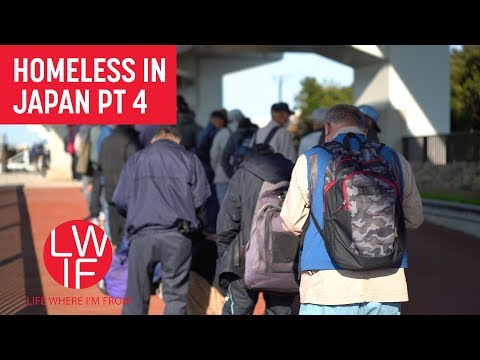
 For more infomation >> LiveStream cu Promovari DonatiiFake si altele - Duration: 24:26.
 For more infomation >> 🔥 Warm Rust Makeup Tutorial | Maria Pol - Duration: 5:32.
 For more infomation >> Por que os meus vídeos são todos em italiano? E mais: como ativar a legenda I Vou Aprender Italiano - Duration: 5:07.
  For more infomation >> TYPOWE SZKOLNE WAGARY 4 - Duration: 7:51.
  For more infomation >> UNBELIEVABLE 2 years transformational video- 2018 - Duration: 3:27.

Không có nhận xét nào:
Đăng nhận xét