For the first time ever, this week's guest video uses art and animation.
12tone is a channel about music theory
that uses pen and paper, and piano notes, and doodles of elephants,
but today they are also talking about language.
12tone: [beeps]!
Hey, welcome to 12tone! Or, to put that another way: [piano notes]!
Ok, that may have sounded like a nice but strange melody,
but it was actually a sentence in La Langue Musicale Universelle,
or the Universal Musical Language, also known as Solresol.
Solresol was invented in the mid-19th century by a French musician named Jean-François Sudre,
who'd become fascinated with the idea of a language made of music.
His first attempt, which he called La Telephonie, was fairly straightforward:
He just took the French alphabet and assigned each letter to a musical note.
This wasn't really a new language, though.
It was more like a code,
and it found its home where most codes do: the military.
Sudre tried to sell his system to the French Army and, later, the Navy,
but despite early interest, they never actually paid him for it.
He even built a series of properly-tuned cannons
in order to increase the volume of his transmissions, but to no avail.
Still, though, he wasn't about to give up on his dream.
Instead, he set his sights on an even more ambitious task:
A universal second language.
His goal was to create a language that was bound to no particular country,
one that every person learned in addition to their native tongue,
allowing free communication across cultural borders.
But just converting French into a musical code wasn't good enough for that.
Sudre was going to have to invent a real language.
To do this, he turned to a system of musical notation known as solfège.
This is that Do-Re-Mi stuff Julie Andrews was singing about.
Well, almost: In The Sound Of Music, the notes are
Do, Re, Mi, Fa, Sol, La, Ti, Do, which is the English method,
but most other countries in Europe use "Si" instead,
and since Sudre was French, that's what he did.
Anyway, having so few possible syllables presents a fairly obvious problem.
In English, it's hard to even guess how many single-syllable words there are,
but one estimate I found puts it at roughly 7,000.
Solresol, on the other hand, has 7.
These are reserved for only the most basic elements of communication,
like "yes", "no", "and", and "the".
Two-syllable words aren't much better: there's 49 possible combinations,
used for things like pronouns, greetings, and common descriptors like "good" and "bad".
They're also used for conjugation:
Solresol can't fit a bunch of different words for each verb,
so instead it has one verb form, the present,
and then just uses a set of two-syllable words to tell you about the tense.
But where things get really interesting are the larger words,
which have the room to build in some structures.
Three-syllable words are loosely divided into groups of 6, based on the first two notes.
Words starting with Sol-Si are based on fun and games,
including "run", "laugh", and "smile".
Words starting with Re-La, on the other hand,
are negative traits like "misanthropy", "distrust", and "intolerance".
At four syllables, he takes this concept to a whole new level,
breaking all the words up into seven groups, called keys,
based on their first syllable.
The key of Do, for instance, is all about humanity,
including the body, mind, and spirit.
The key of Re is for words about the household and family,
Mi is for actions and flaws, Fa is for travel and war,
Sol is for art and science, La is for industry,
and Si is for government.
There's also a second set of keys that come up
when your word includes a note repeated twice in a row,
although their meanings are usually related to the main key.
And that's it.
Sudre's language only went up to 4 syllables,
with less than 3000 total words.
The fifth syllable was left open for future development, in case new words were needed,
but by carefully removing things like synonyms, tense, and parts of speech,
which are managed exclusively through accents rather than new words,
he managed to squeeze quite a lot of meaning into just those 3,000.
Sadly, while Sudre's work made him famous, at least in certain circles,
it never repaid him for the time and money he put into it.
To quote the writer Paul Collins,
"Solresol is, at heart, the philanthropic effort of an idealist –
"and the Brotherhood of Mankind does not issue quarterly dividend checks."
After Sudre's death, though, his wife Josephine took up the cause,
and the language started to pick up steam,
with thousands of speakers and a society for its preservation founded in Paris,
culminating in 1902 with the publication of a guide to its grammar
by the head of the society, Boleslas Gajewski.
But the dream of a true universal language was fading,
so preservationists focused on another of Sudre's selling points: accessibility.
You see, Solresol doesn't actually have to be based on music.
It's got seven characters, and can be grafted onto any set of seven items,
like the seven colors of the rainbow or, more importantly, seven specific hand gestures.
This meant that anyone who knew the spoken language
could easily learn it as a sign language as well,
making it an incredibly useful tool in communicating with deaf people.
Gajewski's guide emphasized this possibility, but there was a problem:
At the time, deaf education in Europe was dominated by a philosophy called oralism,
which is basically the idea that deaf people should still learn to speak,
and that teaching them sign languages got in the way.
To be clear, this is no longer considered a reasonable approach, but for Gajewski,
it meant that the language he loved was cut off from the people it could help the most.
So who knows, maybe if turn-of-the-century educators in France
had been a bit more forward-thinking,
we'd all be speaking in notes right now.
Probably not.
But maybe.
[piano notes]
12tone: [beeps]!
Go subscribe to them for more videos like that one,
I would recommend starting with their video about the Imperial March from Star Wars.
Next week: the last guest video, which features a Canadian.
[beeps]


 For more infomation >> Samsung S8 VS IPhone 7 Plus | Enfrentamiento | Review | Unboxing - Duration: 11:13.
  For more infomation >> ✌️ Inline Skate & Chill Session @ Street Skills Park (#swisstuber Vlog🇨🇭) - Duration: 4:21.
 For more infomation >> Como transformar leads em clientes com o Remarketing - Duration: 9:42.
  For more infomation >> MLK Keynote (Hill Harper) - Duration: 1:50:22.
 For more infomation >> YouTube Monetization Training Part 3 - YouTube Channel Creation - Duration: 7:16.
  For more infomation >> Pulsar 2849 Gameplay Runthrough - Duration: 35:46.
 For more infomation >> Самый удачный выбор собаки по Знаку Зодиака 🐶🐾 - Duration: 10:22.
 For more infomation >> Hollow Knight | Ce jeu qui me perds - Duration: 4:59.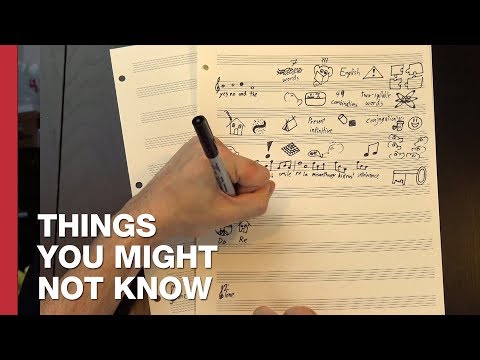


Không có nhận xét nào:
Đăng nhận xét